 14 Oct
57 VAWG organisations write to Prime Minister opposing Earned Settlement proposa...
Today (14th October 2026), 50+ organisations working across the violence against women and...
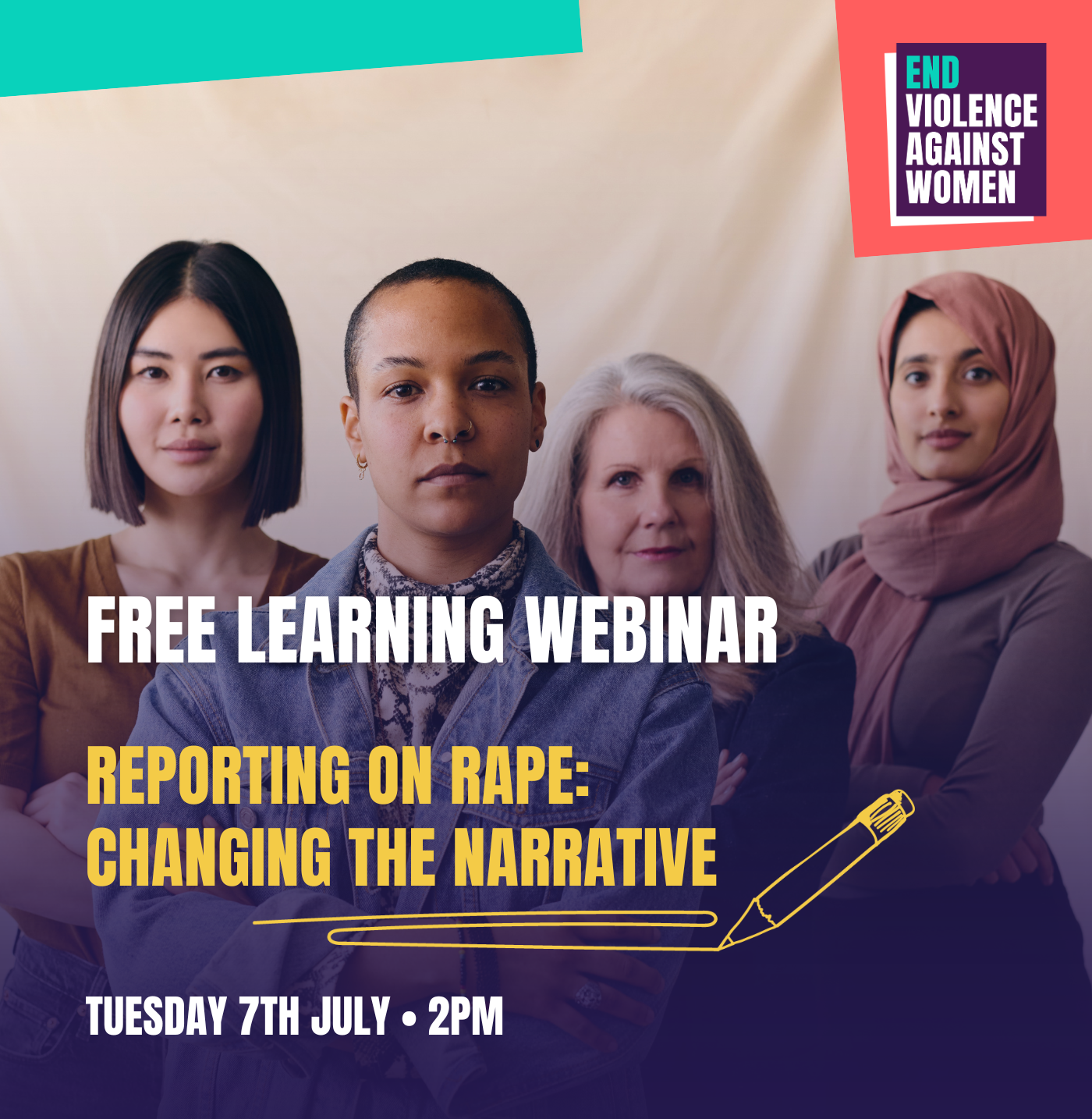
The session will be delivered by journalist, researcher and lecturer Sophie Wilkinson, with contributions from leading academic Dr Alessia Tranchese, author of our 2024 resource Reporting on rape: Changing the narrative.
Based on the guidance in our NUJ-endorsed resource, the webinar will cover:
How the media reports on violence against women and girls has real life consequences – shaping public attitudes and influencing behaviours. Poor reporting can reinforce harmful myths and stereotypes and normalise abuse. But good journalism can inform the public, drive accountability and contribute to social change. It can help survivors identify what happened to them as rape, meaning they might access support and justice.
Journalists have a vital role to play in changing how rape is understood. Join this free webinar to strengthen your reporting with practical tools you can use straight away, and be part of a wider shift towards more responsible journalism.
Sophie Wilkinson is a freelance journalist with over 15 years’ experience working for a range of consumer titles. Through first-person interviews, investigations, news and features for titles such as The Times, The Guardian, the BBC, Channel 4, The i Paper, The Telegraph, Vogue, Grazia, ELLE, VICE and more she has developed as one of her specialist strands a focus on covering violence against women and girls. As well as working on so-called #MeToo investigations, she has uncovered abuses of power across a range of aspects, most notably her award-nominated BBC Radio 4 documentary Missing Pieces, which looked into the scandal of lesbian mothers having custody removed from them in the 70s-90s. She has also recently worked on investigations for The Times into British men attached to Jeffrey Epstein and the alleged escalating pattern of abuse by the Fordingbridge rapists. She regularly posts on TikTok and Instagram about issues relating to VAWG.
Alessia Tranchese is Associate Professor of Language, Feminism and Digital Media. Her research examines how language and media shape public understandings of male violence against women, combining corpus linguistics, discourse analysis, feminist theory, and computational and AI-driven methods for digital media analysis. Her recent projects, supported by the Centre for Advanced Internet Studies (CAIS) and Google Cloud, investigate pornography, online misogyny, and sex education. She is the author of From Fritzl to #MeToo: Twelve years of rape coverage in the British press, which explores the social implications of rape myths in media representations of sexual violence. Her work has been published in leading journals on topics including incels, user-generated reviews in the sex trade, and AI bias in content moderation. She is a regular contributor to national and international media, spanning broadcast, broadsheet, and popular press, and has provided expert commentary for outlets including the BBC, Channel 4, The Guardian, The Observer, Metro, Frankfurter Allgemeine Zeitung, France 24 and Glamour. She serves on the advisory board of the Journal of Language and Discrimination and have provided expert consultancy for competitive funding panels including Horizon Europe, and for international organisations including the UN Special Rapporteur on Violence Against Women and Girls, the European Commission, and Ofcom. She has also collaborated with non-academic organisations, including DEMOS and Full Fact, to inform practical strategies for tackling male violence against women. She has delivered invited talks for women’s rights organisations including the End Violence Against Women Coalition and the Women’s Support Project. Her research has informed policy and practice at multiple levels, including delivering school training on online misogyny.
14 Oct
06 Oct
 28 Sep