 25 Mar
New Snapshot report explores AI, weaponisation and the changing landscape of VAW...
73% say government must do more on violence against women and girls, as new report warns o...
Last night (27th November 2025) the End Violence Against Women Coalition (EVAW) held its annual Write to End Violence Against Women Awards which recognise excellence in reporting on violence against women and girls (VAWG).
Following open public nominations and shortlisting by an expert steering group, the award winners were selected by our panel of judges:
Our outstanding shortlist for our Best News award covered a range of critical issues ranging from abuse of migrant and minoritised women to the criminalisation of survivors, the prevalence of domestic abuse among far-right supporters, and landmark moves to hold abusers accountable for suicide of their victims.
The winning piece for our 2025 Best News Piece award covered the shocking rate of matricide in the UK. More than 170 mothers killed by their sons in 15 years in UK, report reveals, written by Alexandra Topping and Jessica Murray for The Guardian.
Awarding the best news piece, Head of Standards and Regulation at IPSO, Rosemary Douce, said “This was a really powerful piece of journalism, shining a light on the shocking statistics about the number of women killed by their own sons in the UK”. Rosemary noted this impactful piece highlighted systemic issues with mental health services in the UK as well as the sentencing of perpetrators.
In accepting the award, Alexandra thanked and acknowledged the important work of the Femicide Census which informed this piece as well as the Killed Women Count campaign at the Guardian, which reported on the death of every woman at the hands of a man for a year. Jessica dedicated the award to the women who lost their lives, sharing: “telling their stories is by far the most important thing we do.”
Our incredible shortlist for our Best Feature award comprised pieces which explored a range of issues in depth, from online abuse and porn to the harms of strangulation, coercive control of young people and violence against minoritised women.
Awarding the Best Feature Award, judge Yvonne Roberts shared that the shortlist “widened my knowledge of a number of issues in areas which initially might appear familiar but which these contributions prove constantly require investigation and exposure to reveal fresh knowledge and understanding written in ways that compel the reader to sit up and take notice.”
The winner of this year’s Best Feature award is Sonia Sarkar for her article for Migrant Woman Press: FGM in the UK: A Common Sexual Assault on Migrant Women. Yvonne shared that the piece was intersectional, culturally sensitive, aware of the wider context of misogyny and the patriarchy, had a human heart while conveying the insight and knowledge of professionals, campaigners and survivors to offer different perspectives and strong solutions; insight and action. “Thorough investigation and impressive journalistic skill took the issue of FGM a lot further than I had previously read and underscored how so much more needs to be done,” she shared.
In accepting her award, Sonia noted the prevalence of FGM in people’s homes and clinics across the UK, sharing “I really hope this story can lead to investigations and authorities can prevent this crime from happening in such large numbers.”
Our outstanding shortlist for our Best Investigation award exposed critical issues, from tech start ups targeting rape survivors in UK universities, to police use of AI to trawl survivors’ personal data and search engines permitting tutorials on how to perpetrate ‘deepfake’ abuse of women online.
The winner of our Best Investigation award for 2025 was awarded to Hannah Summers and Louise Tickle for their piece Psychologist’s ‘alarming’ views on domestic abuse throw spotlight on family court experts for the Bureau of Investigative Journalism.
Award judge Jackie Long shared that this “was a fantastic piece of investigative journalism, really clearly told”, and that she wanted to recognise just how difficult it is to report from the “still painfully secretive family court”.
In accepting the award, Hannah shared the impact of the investigation into evidence from unregulated psychologists in the family court, with two mothers having recently had draconian court orders relaxed so they can have more contact with their children following years of restrictions. Hannah shared: “The essence of the investigation is not about one individual but a system that permits someone like this who holds these views about domestic abuse and who is not regulated and cannot be held to account by a professional body to wield such power and influence in these really sensitive children’s cases.”
Our brilliant shortlist for the Best Opinion and Comment award comprised pieces that exposed and shattered the shame placed on survivors, normalisation of strangulation in popular culture, to racism being weaponised, to rape culture among children and the rise of tech-enabled abuse. Judge Anita Rani noted that each writer brought “such strength, insight and integrity to their work”.
The winner of our 2025 Best Opinion and Comment award is Jamila Pereira for her piece for Black Ballad, How To Date When You Don’t Trust Men.
Anita said: “Jamila writes with incredible bravery about how surviving sexual abuse can shape our romantic and sexual lives. Her piece breaks silence and stigma, offers practical advice and hope, and brings a vital intersectional lens that centres the experience of Black women.”
Accepting the award, Jamila shared how much the award meant in a time where Black media is being silenced, giving thanks to outlets like Black Ballad for platforming Black writers.
Our fantastic shortlist for our Best Blog and Self-Published award explored misogynoir and its impact on schoolgirls, the hijacking of women’s safety by the far-right, lessons from the TV drama ‘Adolescence’, and how tech platforms are driving outrage and harm for profit. Judge Melissa Sigodo acknowledged the strength of the shortlist, with each writer showing “a skilful ability to capture the many complex thoughts, feelings and opinions sparked by violence against women and girls”.
The winner of this year’s Best Blog and Self-Published award is Jackson Katz for his Substack piece, Netflix’s Adolescence: Ten “Teachable” Takeaways.
Melissa shared that Jackson was able to cut through the noise of what could genuinely be taken away as a teachable lesson, in a way that is captivating, accessible and informative. She noted his piece highlighted “the exclusion of female stories from the narrative, which is a pervasive issue when it comes to writing about violence against women”.
Accepting the award, Jackson shared “we need more accountability from men, we need more leadership from men” on tackling male violence against women and girls.
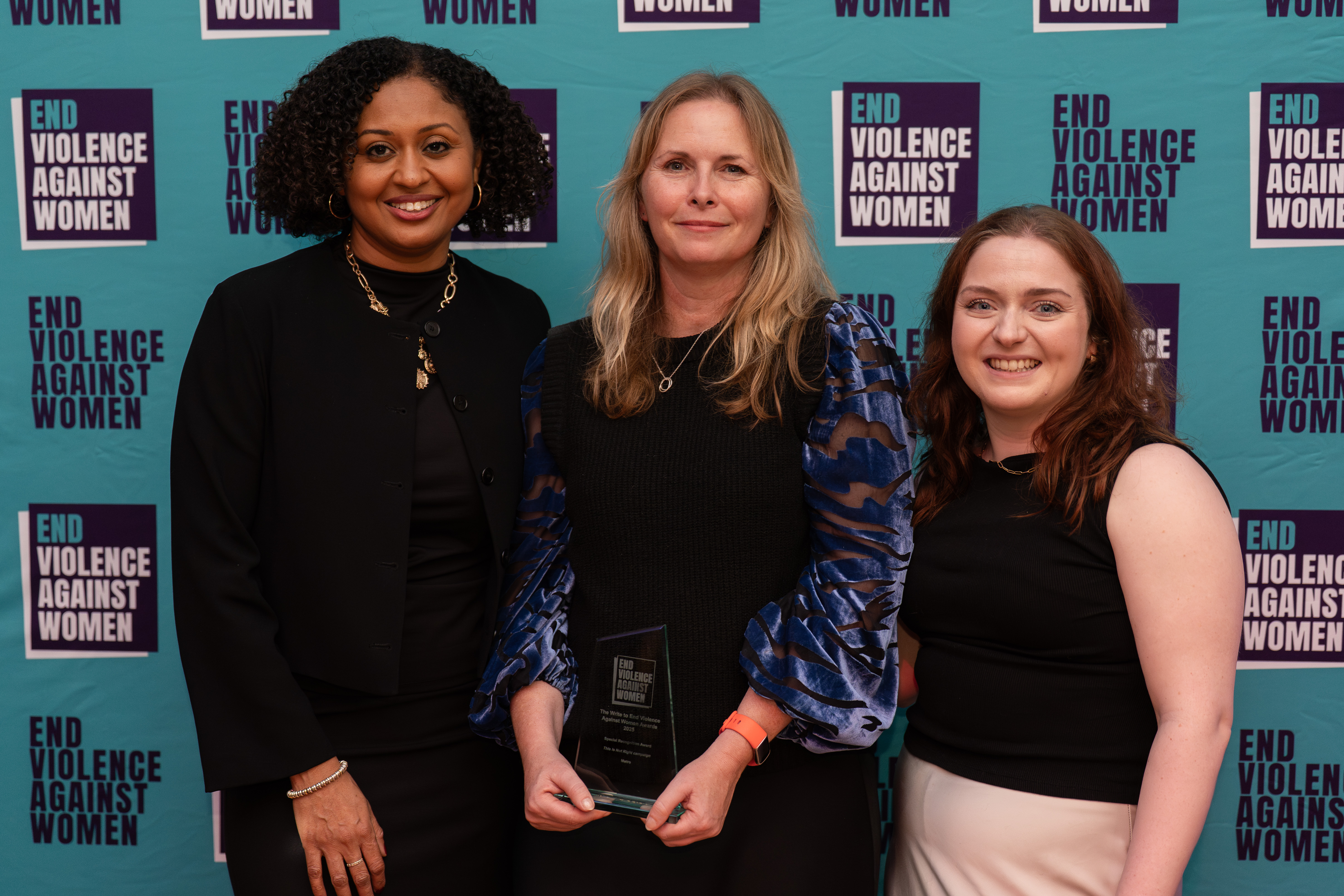
Director of the End Violence Against Women, Andrea Simon, awarded a Special Recognition award recognising the outstanding work of media outlet Metro, led by two dedicated journalists, Jess Austin and Lucy Mapstone.
Awarding our Campaign of the Year award to Metro for the This Is Not Right campaign, Andrea shared that this impactful year-long campaign not only increased the volume and quality of its reporting on violence against women, but changed Metro’s internal practices, policies and training for reporting on VAWG.
She said: “I’m delighted to award our Campaign of the Year award to Metro for their This Is Not Right campaign, a year-long campaign to focus reporting on all forms of violence against women and girls and contribute positively towards social change.
Spearheaded by two women, Jess Austin – First Person and Opinion Editor, and Lucy Mapstone, Entertainment Editor, the campaign aimed to start a conversation about the national epidemic of violence against women and empower Metro’s readers by informing them and highlighting the role they can play in tackling it. And we can really see that they have met this ambition.
This campaign saw news coverage, features, deep dives, first person opinion pieces and more produced each week – prioritising the stories of victims, survivors, family members and activists. In line with Zero Tolerance’s media guidance, the outlet committed to its pieces highlighting that VAWG is a systemic problem, not just a collection of isolated incidents, with the inclusion of fact boxes in each piece. It followed EVAW’s own guidance for journalists on Reporting on Rape, and included this, alongside other expert guidance in its internal training for journalists to ensure responsible use of language in reporting.
The campaign also brought an intersectional lens through, with reporting amplifying Black and minoritised women’s experiences and the ways our justice and social systems are stacked against marginalised women. Many members of our steering group have been involved in this campaign, and have reflected positively not just on the pieces produced as part of this campaign, but the ways in which the journalists have engaged with survivors and expert organisations – from giving good lead in times for survivor interviews, prioritising survivor welling including anonymity when needed, giving survivors read backs so they have agency and control over how their story is presented, and working with specialist organisations for expert commentary.”
Metro’s Deputy Editor Claie Wilson and Deputy News Editor Isobel Frodsham accepted the award, with Claie sharing: “We wanted to create a campaign that wouldn’t shy away from the relentless epidemic but would approach it in a way that would engage, educate and empower our Metro audience. We needed it not only to change the narrative of how people react and absorb stories of violence against women and girls but also consider how the media reports on it”.
Metro published over 350 articles under this campaign over the past year, which have been read by millions of readers.
Our final award of the evening is ‘anti-award’, highlighting a practice that deserves no recognition but demands our attention and action. Each year, we identify a particularly concerning trend that has become widespread in reporting on violence against women and girls. For 2025, we have awarded the Wooden Spoon to a pervasive issue: the weaponisation of violence against women to promote racist, anti-migrant agendas.
Expert speaker Selma Taha, Director of Southall Black Sisters, spoke about why this issue is so critical and what we can all do to address it. She said:
“This weaponisation of VAWG is not new, and has a long history in British society. But it is gaining traction and evolving, with an absolutely devastating impact on women and girls, particularly the Black, minoritised and migrant women and girls that we support day to day. It is critical and urgent that the media – and everyone here – takes a stand against it.
This year, we have seen prominent media outlets and parliamentarians from across the political spectrum cherrypicking and misrepresenting cases, spreading unfounded claims, misinformation and lies – all with the purpose of demonising and scapegoating migrants, asylum seekers and refugees for violence against women – holding these groups as primarily responsible for sexual violence in the UK – and using this as justification for enacting laws and policies that attack our collective rights and freedoms.
All of us have a role to play in ending VAWG. This wooden spoon award is our reminder that sexual violence is not political fodder, nor will its solutions ever be found in demonising people because of their immigration status or the colour of their skin.
We urge anyone genuinely concerned about the epidemic of male violence to reject the weaponisation of VAWG and instead join us in building a world without this violence—one rooted in the defence of our collective rights, our freedoms, and our shared humanity. Because none of us are free until all of us are free.”
“We are delighted to see so many incredible people demonstrating excellence in journalism on violence against women and girls. Their work really does make a difference to our collective attitudes, beliefs, and awareness – moving the public away from victim-blaming, myths and stereotypes and towards accountability and prevention. Congratulations to all the winners and shortlisted writers. You are a shining example of how journalists can be integral to the movement to end male violence against women and girls.”
“The NUJ is proud to support these awards, which recognise the very best reporting and insight on the issue of violence against women. Last night’s awards showed the talent and dedication of journalists throughout the UK who shining a light into this darkest of corners of our society.”
25 Mar
 12 Mar
 05 Mar