 13 Nov
EVAW hosts fourth annual prevention conference
On 21st October 2026, EVAW held our fourth annual Prevention Conference, bringing together...
On 21st October 2026, EVAW held our fourth annual Prevention Conference, bringing together people working to prevent violence against women and girls (VAWG), with a particular focus on children and young people.
The day explored how we can create safer, more equal futures through inclusive education, effective prevention programmes and collaboration across the sector. It brought together young people, campaigners, researchers, educators and frontline practitioners to share their expertise, experiences and ideas on how we can make prevention a reality.
“We just want to be heard. We are the next generation; our experiences need to be heard for our future to be better.”
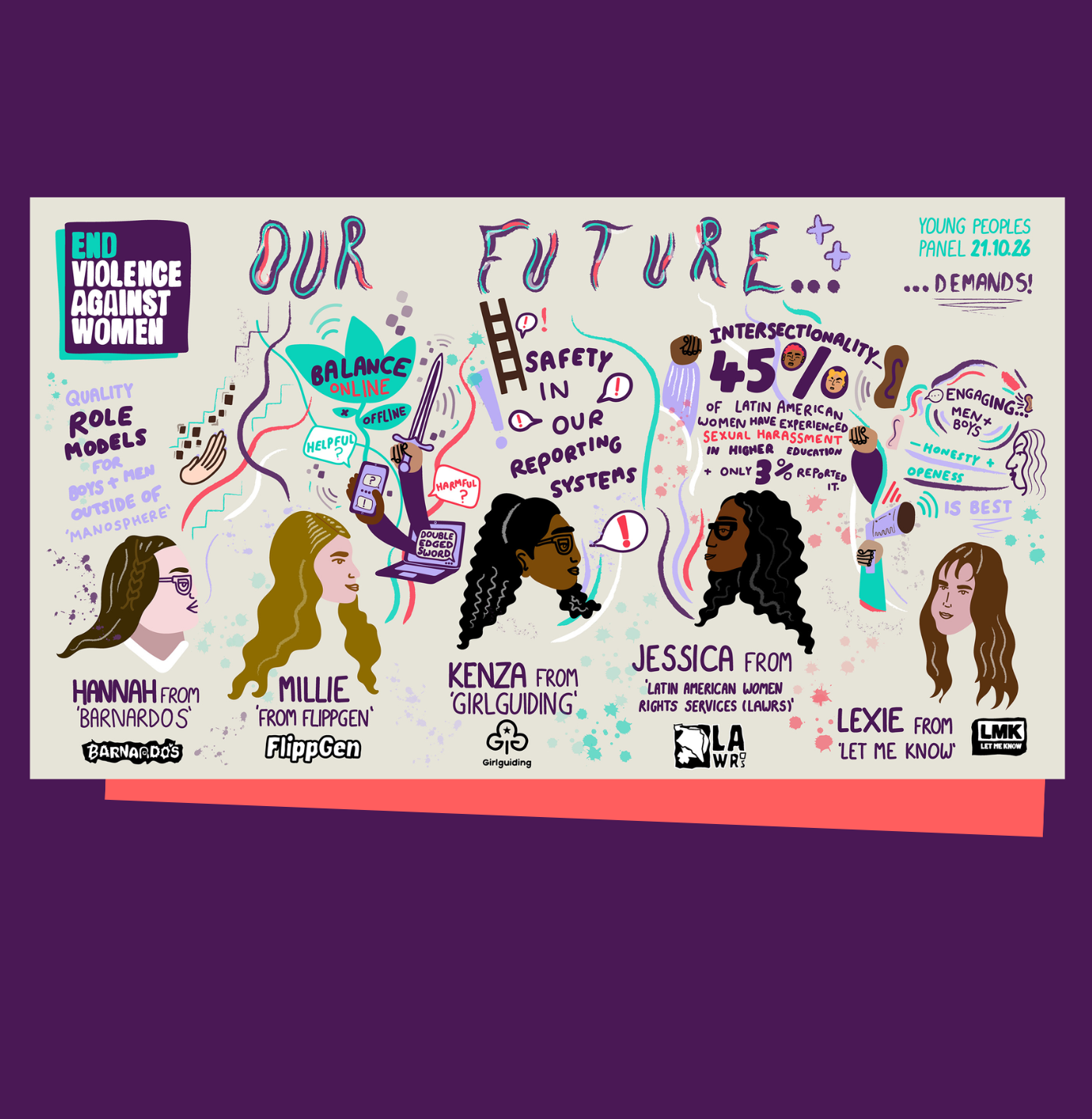
We began with an inspiring young people’s panel, chaired by EVAW Trustee Nicole Walsh and featuring Hannah Scannell from Barnardo’s, Millie Quinn from FlippGen, Lexie Kemp from Let Me Know, Kenza from Girlguiding and Jessica Catalina Mafla Gil from LAWRS.
The panellists spoke candidly about the challenges of growing up today, from the pressures of social media and exposure to harmful online content to the cost-of-living crisis and uncertainty about the future.
They described the internet as a double-edged sword, offering opportunities for connection while also creating spaces for comparison, misogyny and abuse. They also highlighted how the closure of youth clubs and other community spaces is leaving young people increasingly reliant on digital spaces.
The discussion explored how the expectation that young women must constantly be careful and protect themselves shapes their everyday lives. Panellists also challenged the tendency to underestimate young people, calling for their experiences to be taken seriously and for them to have a meaningful role in shaping decisions about their futures. They emphasised the importance of positive role models and constructive ways of engaging boys and young men in challenging misogyny.
Our second panel explored how Relationships, Sex and Health Education (RSHE) can better meet the needs of disabled young people. Featuring Angie Airlie from Stay Safe East, Liselle Terret from the University of East London, Dr Claire Bates from Supported Loving, Storme Toolis from Stay Safe East, Pippa Campbell from Make It Mandatory and representatives from ALLFIE, the discussion highlighted the significant gaps in accessible and inclusive relationships and sex education.
Speakers from Supported Loving highlighted how people with learning disabilities are often excluded from conversations about relationships, sexuality and intimacy. Many receive little or no relationships and sex education, and where it is provided, it can focus narrowly on pregnancy and sexual health, overlooking consent, boundaries, pleasure and healthy relationships.
The panel also discussed the campaign to extend mandatory RSE to 18 through the Relationships and Sex Education (Further Education Sector) Bill. Speakers called for consistent, inclusive and continuous education, supported by mandatory guidance for disabled pupils in all education settings, so that every young person has the knowledge and support to make informed decisions about relationships.
“How do we make sure prevention responds to the realities of different communities?”
Our third panel examined evaluation and evidence-building in prevention work, featuring Niamh Kerr from Rape Crisis Scotland, Sumanta Roy from Imkaan, Vanita Sundaram from the University of York, Ben Moffat from the Youth Endowment Fund and Gill Attrill from UK Research and Innovation.
Niamh Kerr shared learning from Rape Crisis Scotland’s Sexual Violence Prevention Programme, which delivers free, age-appropriate educational workshops to young people aged 11–25 across Scotland. The programme explores consent, power, sexual violence and pornography, encouraging young people to think critically and develop the knowledge and confidence to build safe, equal relationships.
Vanita Sundaram highlighted the challenges of evaluating whole-school approaches to preventing VAWG. While these approaches are widely recognised as essential to systemic change, differences in how they are implemented can make it difficult to measure their effectiveness. She explored how place-based approaches, which recognise the specific experiences and needs of individual school communities, can help develop more meaningful and effective prevention work.
“Deepfakes should be understood not as isolated technological incidents, but as the latest development in a longer continuum of technology-facilitated gender-based violence.”
Our fourth session explored the impact of artificial intelligence on young people and the implications for preventing VAWG. The panel featured Sophie Lennox from Everyone’s Invited, Tallulah Belassie-Page from the Online Safety Network (OSN) and Jonathan Baggaley from the PHSE Association.
Drawing on Everyone’s Invited’s Call it What it is: AI Accelerated Sexual Harm campaign, the discussion highlighted how AI is intensifying existing forms of technology-facilitated gender-based violence, including sexual harassment, non-consensual image-sharing, blackmail and online humiliation. Speakers emphasised that AI-generated abuse cannot be treated as an isolated issue, but must be understood within the wider context of misogyny and online harm. They called for survivor experiences to be centred, stronger safeguarding systems, better education and regulation that ensures technology companies take responsibility for safety.
In our final session, EVAW and Beyond Equality led a practical workshop exploring our Building Bridges: Principles for Work with Men and Boys to End Violence Against Women and Girls guide. Facilitated by Holly Green from Beyond Equality and Annie Poland from EVAW, the session introduced the six principles and explored how they can be applied in different areas of prevention work.
Through practical discussions, participants considered common pitfalls when engaging boys and men, and how to build constructive, accountable approaches that remain connected to the wider goal of ending VAWG.
We’re incredibly grateful to all our panellists, workshop facilitators and attendees for sharing their knowledge, experiences and ideas. This year’s conference reinforced the importance of listening to young people, ensuring prevention is inclusive of everyone’s experiences, and building approaches grounded in evidence and collaboration.
13 Nov
 12 Nov
 09 Nov