 06 Oct
80+ expert organisations call on government to act on sexual violence in schools...
Today (5th October 2026), 80+ organisations working across the violence against women and ...

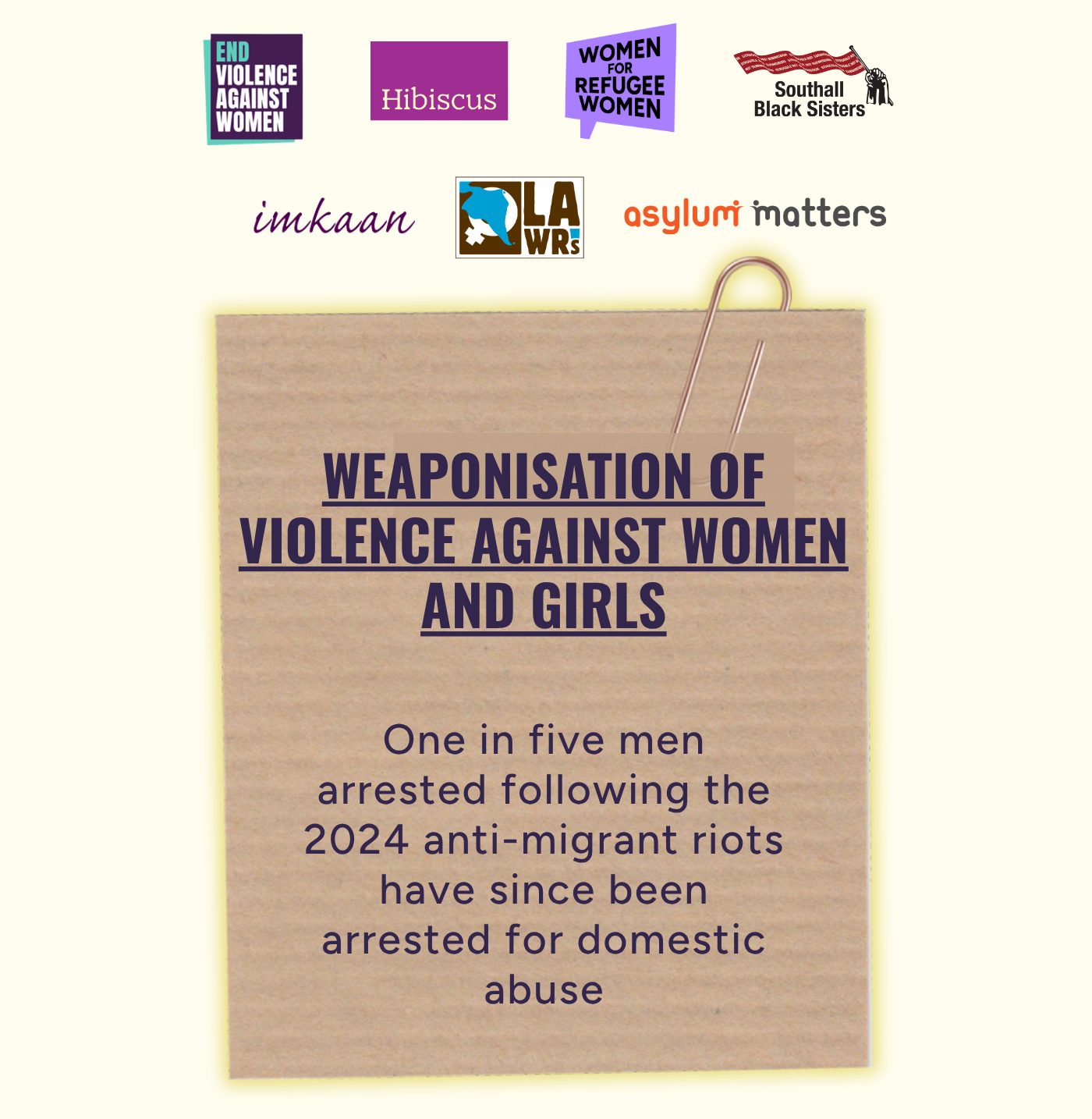
In summer 2024, the UK witnessed 29 anti-immigration demonstrations and riots. Mosques, community centres, libraries and hotels housing asylum seekers were targeted in 27 towns and cities across England and Northern Ireland. Many of those involved claimed to be acting in defence of women and girls, using slogans such as “protect our women” and “save our girls” – a narrative that recent police data calls into serious question. That data shows that a striking proportion of those arrested during the riots have themselves been reported to police for domestic abuse, both before and since the disorder.
This violence, which followed the horrific murder of three young girls at a dance class in Southport, was fuelled by false claims online, with rioters ignoring the pleas of bereaved parents and using the appalling violence against these girls as an excuse for taking part in racist violence. These events were not an isolated episode. In recent years, concerns about violence against women and girls (VAWG) have increasingly been appropriated by far-right and anti-migrant groups to advance divisive political agendas. Rather than addressing the realities of male violence, such narratives misdirect public attention, distort understanding of who perpetrates abuse, and fuel hostility towards migrant and minoritised communities in the UK.
With this in mind, the police data reported in the Guardian warrant serious attention. They reveal that one in five people arrested during the 2024 anti-migrant riots have since been reported to police for domestic abuse, adding to earlier findings that two in five had already been reported for domestic abuse before the disorder took place. It points to what we, specialist organisations working with women who have survived sexual and gender-based violence, have known for a long time: most cases of men’s violence against women and girls are perpetrated by men who are known to the victim-survivors.
This data also indicate a worrying trend: a significant overlap between perpetrators of public violence, violence against women and girls, and anti-migrant rhetoric. If this weaponisation of violence against women and girls is left unchecked, it will continue to fuel violence, deepen division, and undermine the respect and freedom of our communities.
This matters because much of the disorder was justified in the name of protecting women and girls. When concern for women’s safety is used as a rationale for hostility towards migrant and minoritised communities, it tends to obscure rather than address the realities of abuse that women experience. Women’s safety becomes politicised and weaponised. And this shows us that weaponising violence against women and girls to justify anti-migrant disorders obscures the realities of abuse that women experience, misleads the public about its perpetrators, and allows its underlying causes to remain unchallenged.
For victim-survivors, and particularly for Black, migrant and minoritised women, the consequences are damaging. Public attention and resources are diverted towards scapegoats that do not reflect the lived realities of abuse, while the specialist services that victim-survivors rely on remain under-funded and overstretched.
These findings demand more than acknowledgement, as such, we are calling on the Government to:
The weaponisation of violence against women and girls is not inevitable – it is a political choice, and it can and must be challenged. We stand ready to work with policymakers, practitioners and partners to make these changes a reality. But women’s safety must never again be turned into a weapon against the communities they belong to.
06 Oct
 28 Sep
 25 Sep