 14 Oct
57 VAWG organisations write to Prime Minister opposing Earned Settlement proposa...
Today (14th October 2026), 50+ organisations working across the violence against women and...
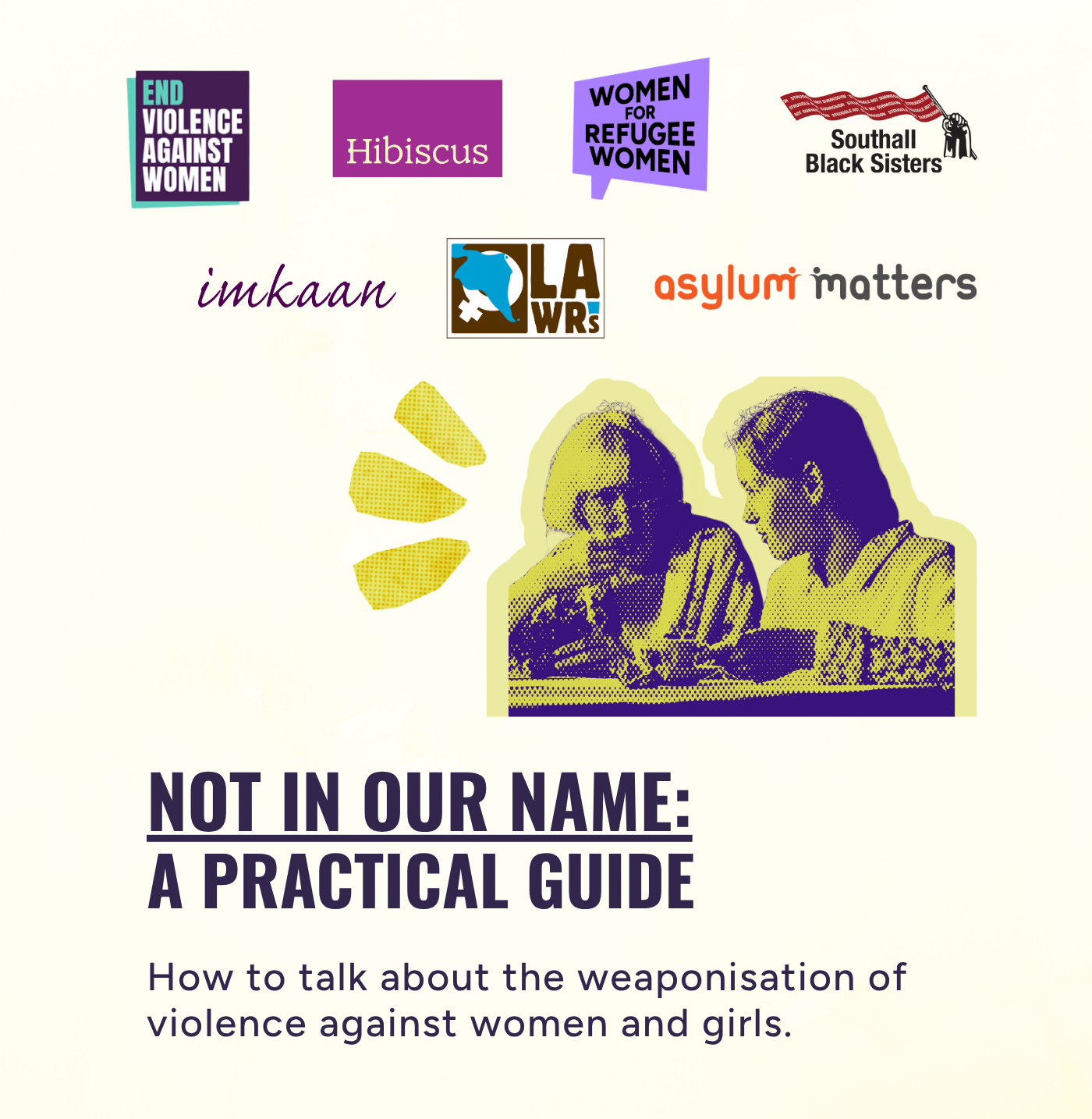
The use of arguments about VAWG to promote anti-migration agendas is “nothing new”, but its impact is becoming more mainstream and “devastating”. A new guide, produced by End Violence Against Women Coalition, Hibiscus, Women for Refugee Women, Southall Black Sisters, Imkaan and the Latin American Women’s Rights Service, aims to help the public, politicians and journalists respond to those who use false or misleading claims about violence against women to stoke division for political gain.
The guide provides tools for people to challenge harmful falsehoods and to have productive conversations with the people in their lives about VAWG and immigration. It urges people to unite over shared positive values in order to tell a more honest story, helping people to understand the real causes of, and solutions to, gendered violence.
Introducing the guide, the organisations said:
“In moments of national tragedy, misinformation about VAWG has been used to spread anti-migration rhetoric to scapegoat and divide communities and stoke further violence.”
“This is not limited to isolated incidents – it is reinforced daily on social media, in the news, and even in Parliament. The weaponisation of VAWG has spread rapidly, and if left unchecked, it will continue to fuel harm, deepen division, and undermine the respect and freedom of our communities.”
“VAWG is not a tool for political point-scoring. It is not a justification for racism, xenophobia or hostility. And yet it is increasingly used in this way, wielded as a weapon to target migrants, refugees, and people seeking asylum, and to make our communities less safe.”
The guide comes after more than 100 women’s rights groups united last year in an open letter to the Government, calling for “leadership” in responding to racist misuse of concern about women and girls’ safety. In the new guide, the organisations that coordinated the letter say an end to violence against women and girls is possible – but that weaponisation of the issue reinforced the ‘stranger-danger’ myth and takes attention away from the real causes of and solutions to violence, while putting Black, minoritised and migrant women, and survivors, at risk of more harm.
“The public overwhelmingly cares about ending violence against women and girls. But this concern has been increasingly exploited by those who promote misinformation and stoke fear and division in our communities. To those figures, which includes politicians, organisations on the frontlines of tackling violence against women and girls say ‘not in our name’. Ending violence against women and girls is everyone’s responsibility, and we can all take small, everyday actions to get us there. This guide is designed to help us do just that. It offers practical advice to challenge misinformation, move conversations away from harmful narratives and towards a better world for all women and girls.”
“The surge in disinformation that twists violence against women and girls to scapegoat people seeking safety in the UK, to sow fear and division, and to further political goals is not just an abstract rhetoric, but has real life consequences. Women seeking safety in the UK already face profound barriers to protection, and these false narratives fuel hostility, deepen mistrust, and sow divisions in our communities, making it much harder for refugee women to rebuild their lives here. That’s why this guide is so important today: it equips people with the tools to challenge harmful myths and to stand firmly with women, girls, and humanity when it is needed now more than ever.”
”The rise of the far-right is not just shaping public discourse on violence against women and girls – it is distorting it. VAWG is being weaponised to scapegoat migrant communities and legitimise racist, anti-migrant narratives, while obscuring the reality that this violence is systemic, rooted in patriarchy, inequality, and state failure.
For Black, minoritised and migrant women, this creates a brutal double bind; they are targeted by xenophobic rhetoric while being erased as victims-survivors, pushing them further from safety, support, and justice. Hostile immigration policies, including No Recourse to Public Funds and recent immigration changes, already trap women in abuse, yet these realities are ignored in favour of divisive myths.
This guide is a timely intervention. It equips people to challenge misinformation and refocus attention on the real drivers of violence. Ending VAWG requires systemic change and protection for all women – not the exploitation of their experiences to justify racism.”
“The weaponisation of VAWG serves a dual purpose: it fuels racist profiling that casts certain communities as perpetrators, while simultaneously denying Black and minoritised migrant women recognition as victims‑survivors. In reality, VAWG is a pervasive societal issue, rooted in patriarchy and present across all communities, cultures, and classes.
The conflation of migration with criminality and policymaking based on this approach fractures communities and creates additional risks for victim‑survivors of abuse. There is an urgent need to address the true drivers of violence and to invest in solutions that ensure safety for all women and girls, including access to justice, secure housing, and specialist support services.
This guide challenges the weaponisation of VAWG by offering the public alternative ways to confront harmful narratives and encouraging a focus on structural causes, including the government’s failure to tackle this pervasive form of violence. We must remember that the state holds responsibility for addressing VAWG, which must include meaningful support for migrant women and sustainable funding for a comprehensive, inclusive response.”
“The weaponisation of VAWG is not accidental, it is rooted in structural inequalities and reinforced through hostile immigration narratives and state policies. It is used to justify the racist narratives that scapegoat migrant communities, while ignoring the systemic drivers of abuse.
This distortion disproportionately affects Black, minoritised and migrant women. When VAWG is framed through misinformation and ‘othering’, the barriers to safety are intensified, pushing women further from protection and justice.
Rhetoric that conflates migration with harm fuels division and legitimises exclusion. This is where this guide comes into play, to help people challenge these narratives in their everyday lives.
If we are to see meaningful change, we can all endeavour to shift the narrative towards one that is grounded in evidence, accountability, and the lived realities of all women and girls. Only then can we begin to build a response to VAWG that truly ensures safety and justice for all.”
“Black and minoritised women bear the racist and xenophobic brunt of the weaponisation of VAWG, as they experience the severe harm done to our communities whilst simultaneously being pushed further and further from the safety and support that every victim-survivor should expect. Specialist VAWG services led ‘by and for’ Black and minoritised women are on the frontlines of how the rise of the far-right is harming Black and minoritised communities, with many services having to take additional safety measures just to protect their staff and service users from the risk of far-right violence. This is the real-life impact of the weaponisation of VAWG and it must end. There is an urgent need to tackle the root causes of VAWG, compounded by intersecting inequalities, and invest in long-term solutions; but the divisive, hate-fuelled rhetoric of recent public discourse, matched by increasingly hostile immigration policies that prevent migrant and asylum-seeking women from accessing protection and support, does nothing to address this.
This guide is designed for anyone who truly cares about ending violence against women and girls and wants to see an end to division and misinformation stoked by the far-right. It offers practical, everyday help with challenging harmful narratives and shifting conversations towards what is needed to end VAWG. Violence against women and girls affects everyone, and we will only see the end of it if we confront racist, anti-migrant myths and focus on the systemic change needed so that all women can live their lives free from violence.”
14 Oct
06 Oct
 28 Sep