 25 Mar
New Snapshot report explores AI, weaponisation and the changing landscape of VAW...
73% say government must do more on violence against women and girls, as new report warns o...
Today (6th February 2026), following months of campaigning by survivor Jodie*, End Violence Against Women Coalition, #NotYourPorn, Professor Clare McGlynn and Glamour UK, a new law comes into force making it a criminal offence to create or ask someone to create a sexually explicit deepfake of someone without their consent, or to solicit a deepfake. This is a welcome and long-overdue positive step for survivors.
The new offence was announced in January 2025 and finally comes into force under the Data Use and Access Act 2025 after the Grok scandal, which saw 3 million sexualised images produced. While it should not have taken this long to enact the new law, and many women and girls have been harmed in the delay, criminalising the creation of deepfakes is an important step towards tackling this abuse.
But it is not ‘job done’: without enforcement of the law, adequate regulation of tech companies and civil routes to justice, women and girls will remain exposed to abuse and survivors left to fend for themselves.
As access to AI and nudification apps increases, so does the proliferation of image-based abuse, such as non-consensual deepfakes. 96% of deepfakes are sexually explicit, and 99% of those depict women.
Around 3 million women and children were victimised by Grok alone, showing the scale and speed at which this abuse is spreading.
Deepfake abuse causes profound harm to victims, including significant psychological trauma, impact on employment opportunities and interpersonal relationships, silencing of women’s voices online and withdrawal from public life. The threat of this abuse is affecting women’s freedoms, including our freedom of speech.
“This moment belongs to survivors and campaigners in the UK and beyond who have spent years pushing for the most basic right to have control over our own images. Women and girls should never have had to fight this hard to be protected from a form of abuse that is so clearly devastating and intrinsically gendered.
While I am relieved that the law is finally being brought into force, it is impossible to ignore that it should have happened last year, when it received Royal Assent. That it has taken the Grok scandal, and the creation of yet more victims, to force action is deeply disappointing. This delay has caused real, avoidable harm.
This campaign has always been about more than one platform or one moment in the news cycle. It is about recognising image-based abuse as a serious form of sexual violence, keeping pace with rapidly evolving technology, and ensuring survivors have meaningful routes to justice and support, and that those routes are properly funded. Today [Friday] marks how far we’ve come, but also how much further we still have to go. The work does not stop here.”
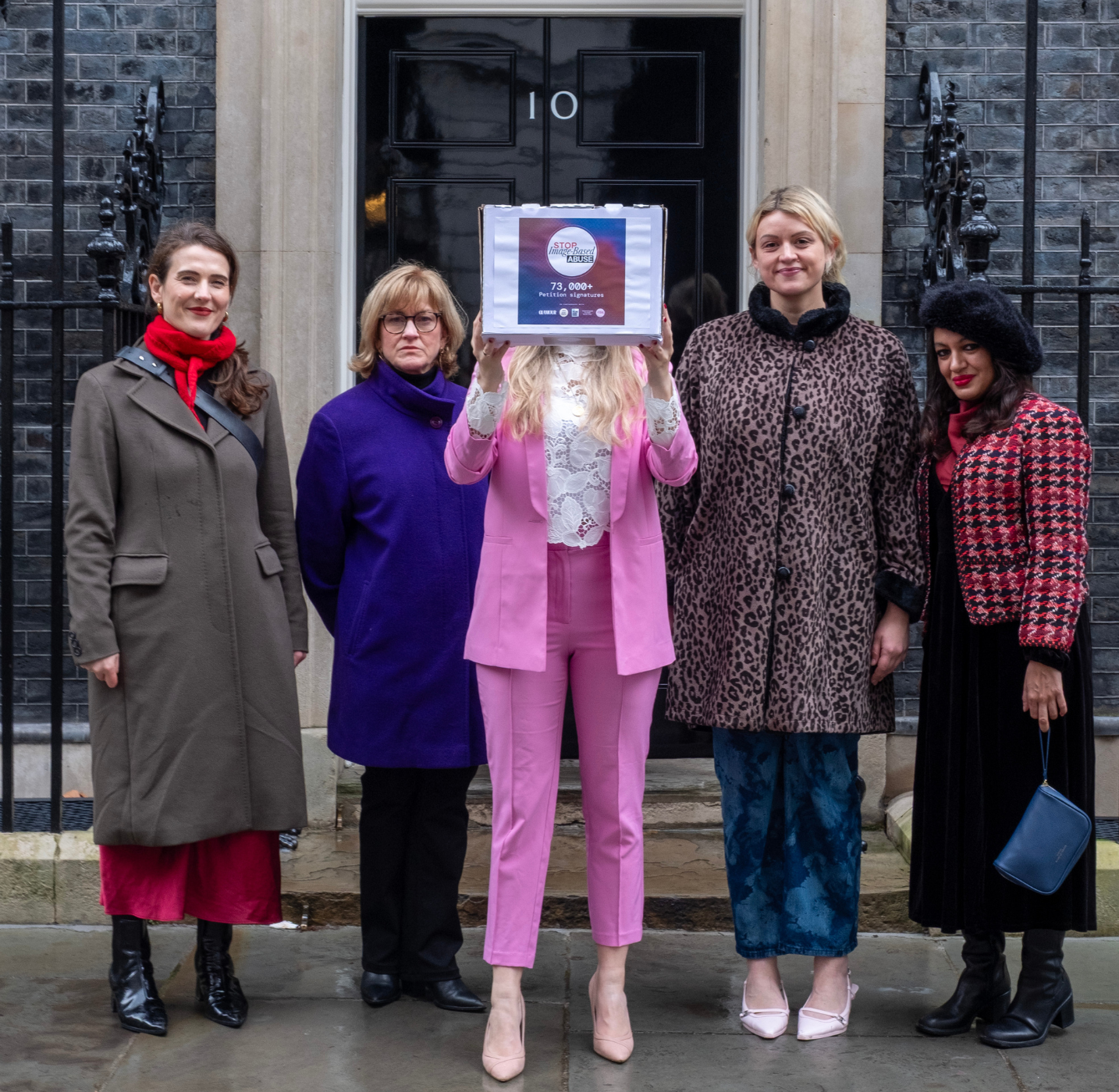
Today, Jodie and her fellow campaigners delivered a 73k-strong petition to No 10 Downing Street calling for the government to go further than criminal offences alone and focus on regulating Big Tech, which is promoting and profiting from abuse of women and girls.
This abuse is happening at an industrial scale and until tech platforms are forced to prioritise women’s safety over profit, the problem will continue, no matter how many criminal offences exist.
Our campaign is calling for the following measures to stop image-based abuse:
“Every day women face the threat of being deepfaked, a devastating violation that can shatter lives. This new law is a vital step towards ending image based abuse. But it’s only the start.
We need comprehensive reforms that give women rights to get material taken down and deleted. We need a regulator that will take proactive and robust action against deep fake and nudify websites and apps.
And we need these actions urgently. Legal changes do not need to take years. We just need to prioritise acting against this industrial scale abuse of women and girls.
This new law sends a clear message that deepfake sexual abuse is wrong and crimimal. This provides the foundation for action, we now need to build on its foundations by granting civil rights to women and girls to get imagery removed and deleted. We also need strong action to ensure that platforms are held to account.”
“It is thanks to the determination of victims and survivors like Jodie that this law comes into force today. Far too many women and girls have paid the price for a global failure to properly regulate online platforms which will always choose profit over the safety and wellbeing of users.
This is a momentous step in the right direction but the government and Ofcom must go further. This means more support for survivors, more routes for take downs and removals, and robust and effective regulation.”
“In the noise about this law being a Government success story, we must champion the stories of survivors behind the scenes, like Jodie, who didn’t give up and fought every day to be heard. This law has been crafted from Jodie’s experience and we are indebted to her for fighting for the rights of women and girls despite the enormous personal cost.
Although we are pleased the law is coming into force, it shouldn’t have taken a year or public outrage to bring it into fruition. This is a sobering reminder of how survivors lead change and that listening to survivors early on is not optional, it is essential to preventing harm. This is not the time to become complacent with the wins, there is much left to do and survivors like Jodie are at the heart of the solutions.”
“We are heartened and honoured to be part of this survivor-led movement to eradicate image-based abuse.
Today is a testament to all the survivors and victims of image-based abuse who have spent the last few years tirelessly campaigning and sharing their stories to make this change. We stand with survivors and reiterate that Glamour UK will always be a safe space for their stories.”
25 Mar
 12 Mar
 05 Mar