 14 Oct
57 VAWG organisations write to Prime Minister opposing Earned Settlement proposa...
Today (14th October 2026), 50+ organisations working across the violence against women and...
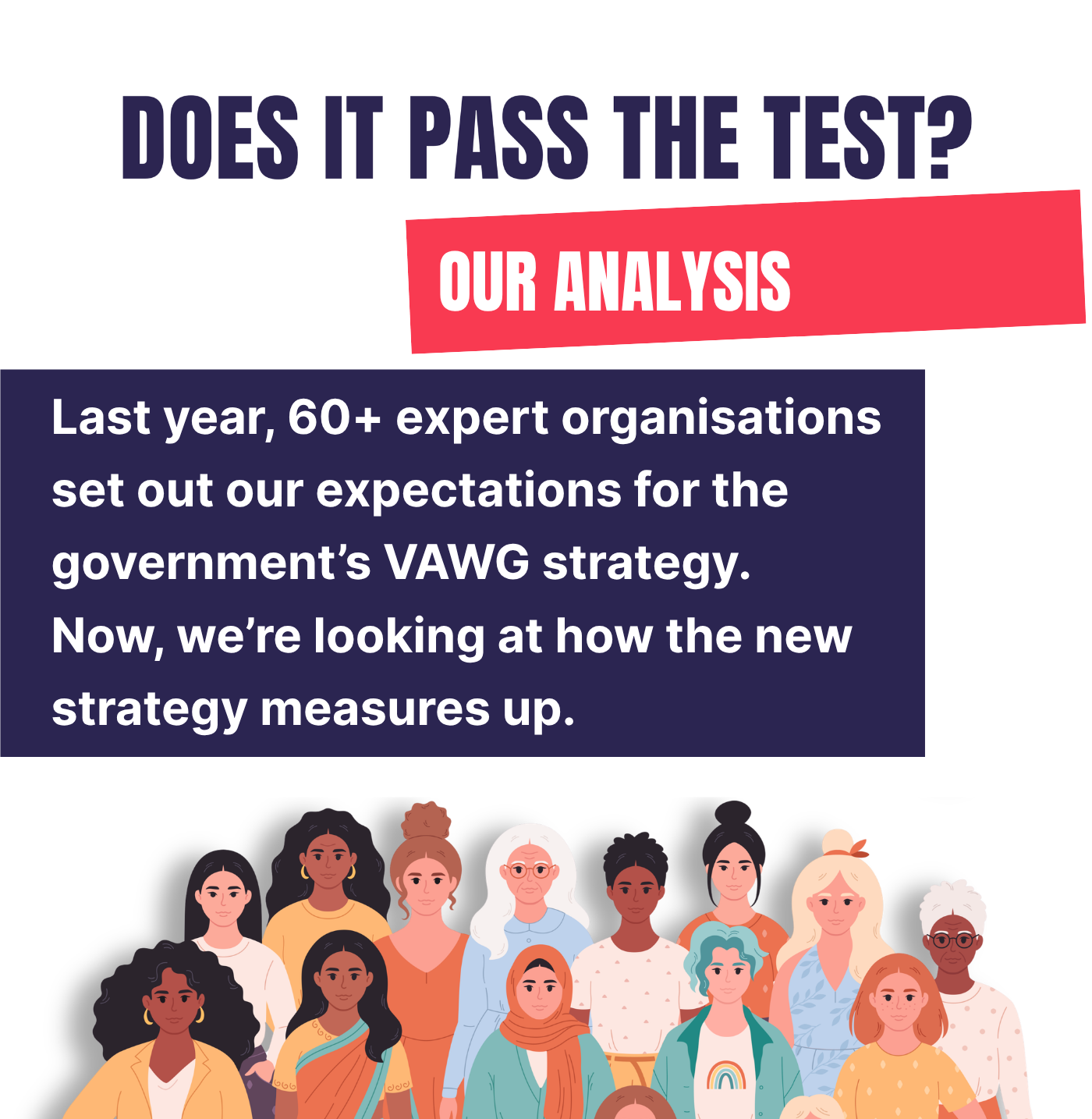
Last year, the End Violence Against Women Coalition (EVAW) and 60+ other expert violence against women and girls (VAWG) organisations set out our expectations for the government’s long-awaited VAWG strategy, following concerns about its delayed publication.
We set out five key tests that the new strategy must meet in order to meaningfully tackle and prevent VAWG:
✅ Focus on prevention
✅ Address all forms of VAWG in an integrated way
✅ Include all women and girls without discrimination
✅ Sustainably fund specialist support services
✅ Accountability across all government departments
With the government’s landmark strategy finally published in December 2025, our latest analysis looks at how it measures up against our five key tests.
This strategy has a welcome focus on prevention, particularly the education of children and young people. However, if the government is to meet its ambitions in this area it must substantially bolster the accompanying funding, and note that increased awareness will increase referrals to specialist services who remain chronically underfunded.
We are also pleased to see the prominence of tackling online harms in the strategy, including a focus on AI, a ban on nudification apps, and numerous references to ‘safety-by-design’ and media literacy. However, there is an urgent need to think outside the box of criminalisation and accelerate the pace of work in light of the evidence already available, scale of harm, rate of technological advancements and the ongoing impunity of tech companies.
Beyond education for children and young people, we welcome the commitment to a long-term national programme of public behaviour change campaigns – something EVAW has long campaigned for. These must be multi-year and sustained, and shaped by the input of expert VAWG organisations.
We are pleased to see all forms of VAWG reflected in the strategy, albeit to varying degrees of ambition with regard to actions, joined up thinking and funding: noting the ongoing precarity of many frontline services including ‘by and for’ and specialist sexual violence services.
There is a lack of recognition of state violence, i.e. the direct harm many of the government’s own systems cause women. For example, how hostile asylum policies perpetuate and exacerbate violence against refugee and asylum-seeking-women.
The metrics proposed to measure halving VAWG, and sub-metrics linked to strategy, cover a much more limited range of VAWG. Furthermore, the government notes a lack of disaggregated data to understand how impact differs among different groups of women.
Despite some positive rhetoric on inequalities in the strategy’s narrative, and a welcome commitment to the value and funding of ‘by and for’ services, the strategy is at best inconsistent in its application of a principle of equality and anti-discrimination.
Critically, we are concerned that a number of the measures in the strategy actively undermine commitments to equality, and will cause direct harm to minoritised survivors. This includes the weaponisation of VAWG to pass restrictive immigration policies, opening up opportunities for the targeting of racialised communities with the potential misuse of data, and increasing levels of state surveillance with technology known to function with racial bias, i.e. facial recognition.
There is also little mention of the experiences of disabled7 or LGBT+ survivors, and while the proposed requirement for police to seek a survivor’s consent before sharing their information with Immigration Enforcement, this does not amount to a full, unconditional firewall.
There are a number of welcome funding commitments for specialist support services, with much greater cross-government involvement and recognition and a commitment to the provision of ‘by and for’ services. However, we are still missing much of the detail to make firm conclusions, and in light of the chronic under- and short-term funding of the sector for many years, alongside a likely increase in demand (as a result of proposals in the strategy), these funding commitments do not yet go far enough to meet the needs of survivors with a sustainable specialist sector.
However, it is positive to see a commitment to ‘radically overhaul the support services commissioning landscape’, which for too long has structurally disadvantaged services led by and for Black, minoritised and migrant women.
This strategy represents the most cross-government piece of work on VAWG to date: a welcome shift in the right direction, notably bringing health to the table.
In order to match up to the strong narrative of a ‘whole-society’ and ‘cross-government’ response, its success will rely heavily on good strategic oversight to ensure its disparate parts are brought together as a whole. This would help overcome what currently appears more of a scattergun approach, with an unwieldy action plan that lacks structure, focus and milestones, and actions ranging hugely in detail, scale and relevance.
However, both actions and metrics are still disproportionately weighted towards criminal justice responses, which needs to be addressed.
14 Oct
06 Oct
 28 Sep